Adventures in the Allegheny National Forest
Last Monday, I went to sleep in a van behind Brumbaugh Academic Center, and woke up in Allegheny National Forest. It was quite the pleasant surprise.
This semester, I decided I wanted to put off taking Macroeconomics on campus, and take Forestry at the Raystown Field Station. I knew it was going to be a little tricky, seeing that classes at the Field Station are an all-day commitment, and Forestry was on Monday. I couldn’t simply drop all of my Monday, Wednesday, Friday classes. Luckily, after talking it through with my professors, they let me off class on Mondays and I was all set to go take a class at the Field Station.
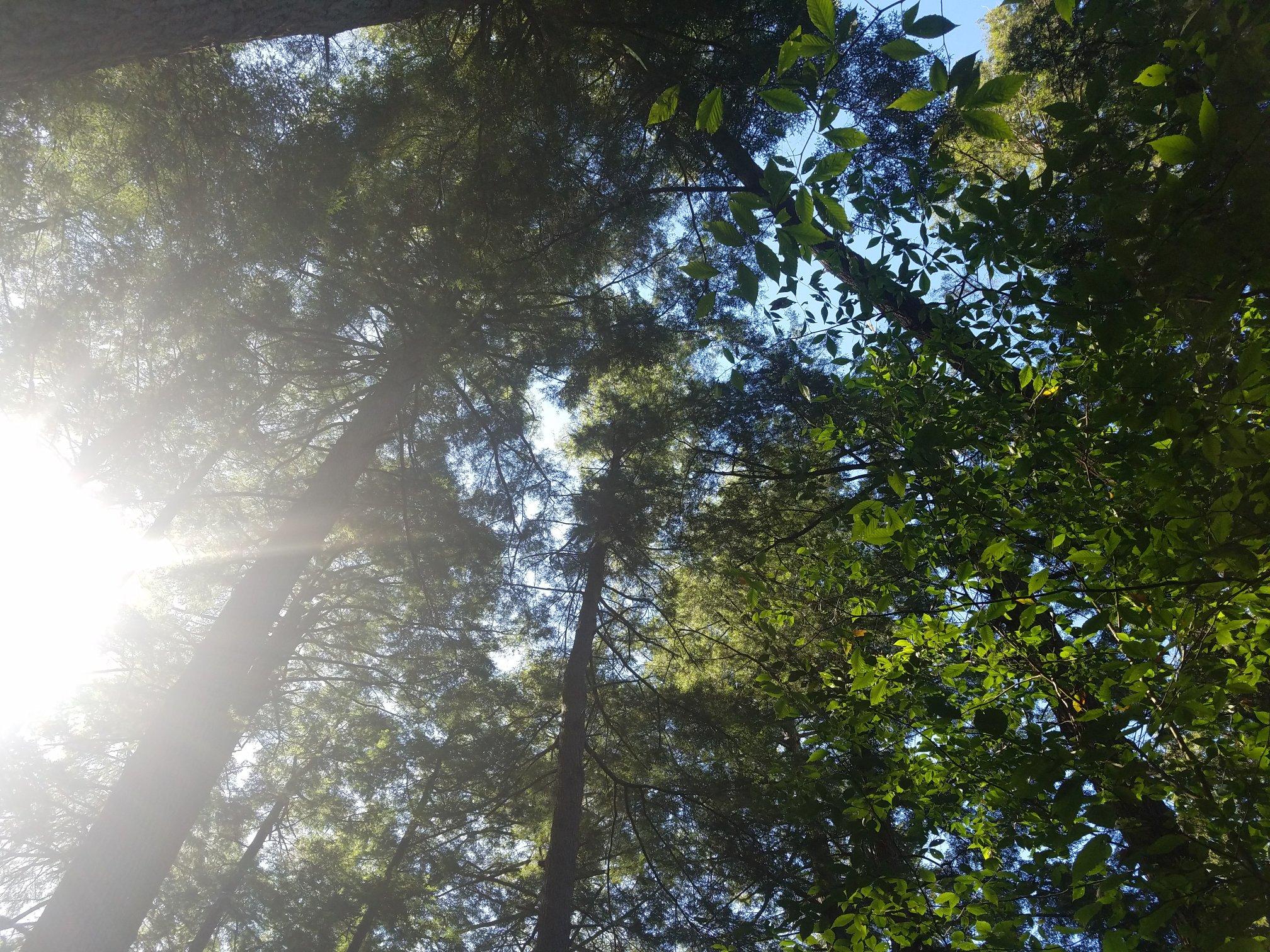
And that’s how I ended up in Allegheny National Forest at 10 AM on a Monday. We started off the day with a lecture on the history of the forest and its current uses. Our lecturer was a part of the research division of the National Forest Service, where they test regeneration, silvicultural (growing trees as crops) practices, and any other research question they can imagine.
After our morning lecture and a quick lunch, we were off to a very famous part of the forest: the Tionesta Forest.
This forest has been untouched by the hands of humans for over 400 years. It was originally dominated by beech and hemlock trees, but many of the trees were blown down in a storm 40 years ago. Now, beech bark disease and hemlock wooly adelgid (both forest pests which kill those species), seem to be slowly changing the composition of the forest. Because of the struggles these species are facing, it is unknown if they will ever grow to such monstrous proportions again, at least in this area. It was incredibly cool to see these giants in person – my arms didn’t even reach halfway around the trunks of some of the trees.
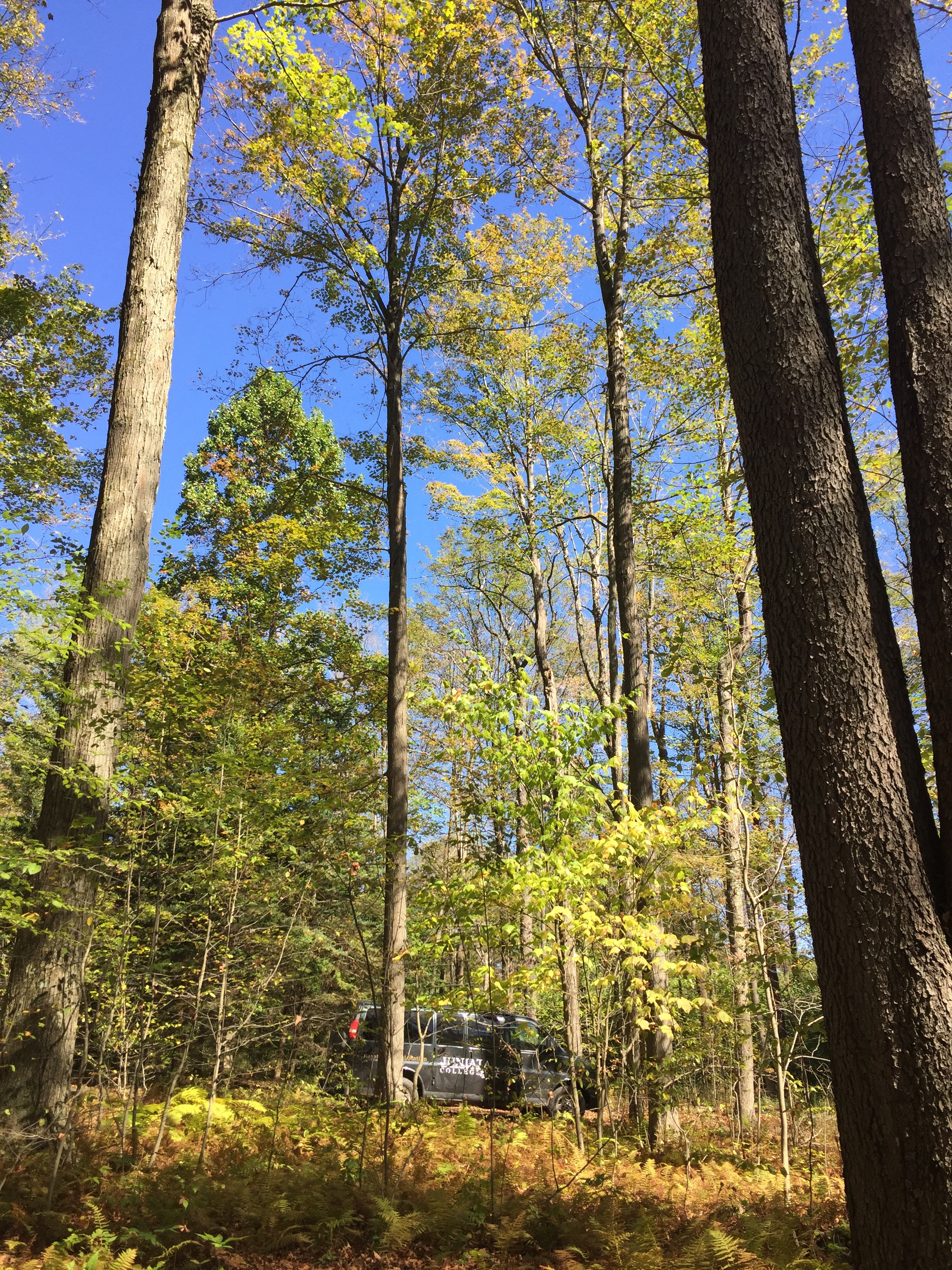
As the day finished up, we packed back into the vans to leave. It was a busy three-hour ride back to campus with a Sheetz stop, hair braiding, and napping. There is always plenty of napping on the long van journeys.
This week, I will be setting off on another long journey with the Forestry class. We are taking a week-long tour of forests in New England, and I couldn’t be more excited. I knew classes at Juniata could take me amazing places, but this course has been even more incredible than most.
Chilling Revelations from a Nobel Laureate
A few weeks ago, Juniata was visited by a very special guest, Dr. Bill Phillips of the Juniata College graduating class of 1970 and one of the 1997 Physics Nobel Laureates. Despite his huge success in his field, Dr. Phillips has not forgotten where he got his start, a small Liberal Arts college nestled in the hills of central Pennsylvania. Dr. Phillips comes back every four years to give talks about physics and to interact with current Physics students, and others as well. I’m sure he has many reasons for why he does come back, but I’d like to think that he mainly does it to inspire younger generations, to instill within them a belief that they can do anything and go anywhere with hard work and the right attitude.
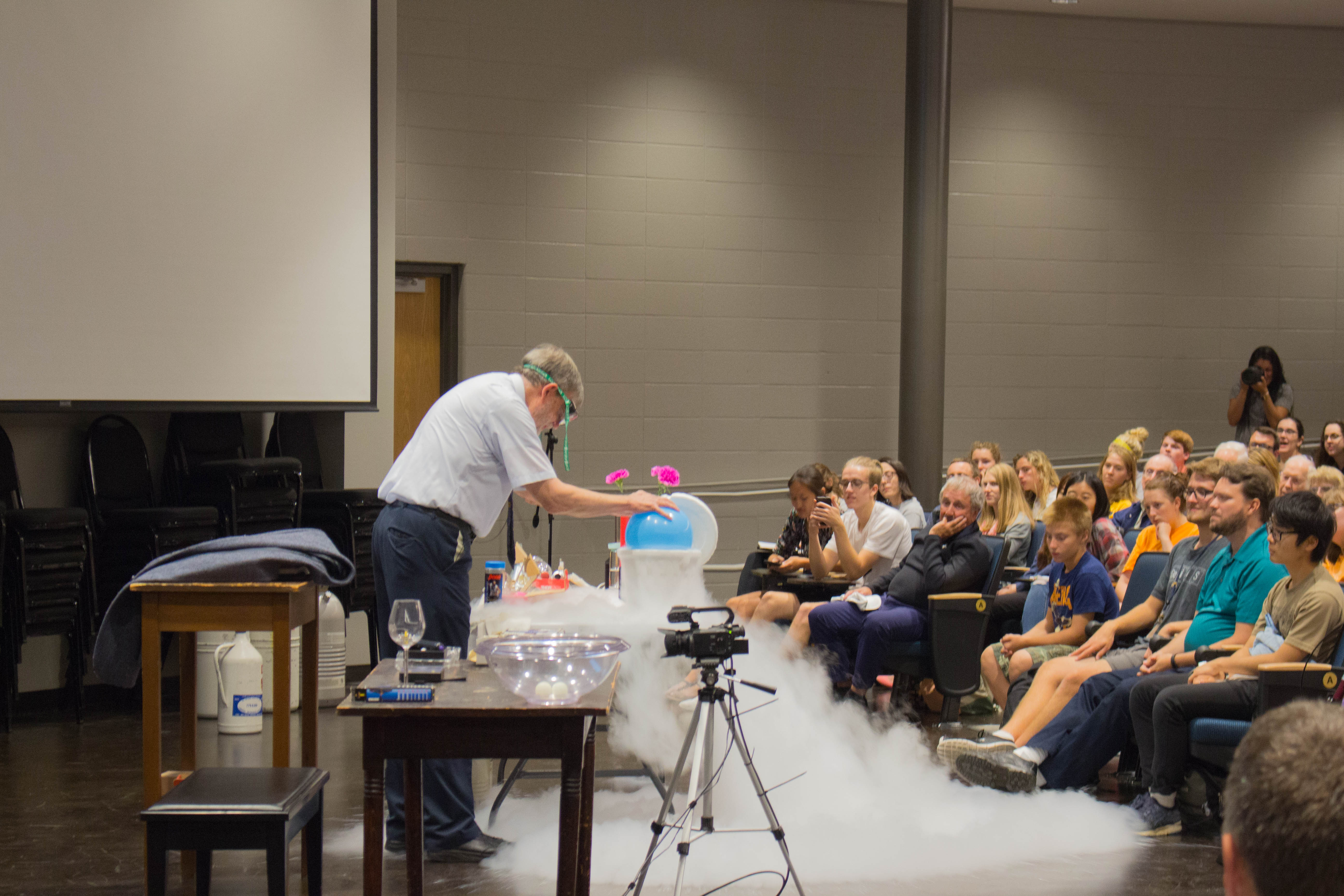
His own attitude is one of positivity and an almost childlike sense of curiosity and fascination with physics, even after a lifetime of in-depth study. His energy and enthusiasm was contagious and I found myself excited for each new physical property that he introduced, despite my small amount of disdain for the field of physics. He bounced from one side of the stage to the other, always talking, his hands always moving as he described the intricacies of time and its relation to the coldest temperature ever recorded. During the talk, I roamed through the crowd and behind his presentation setup taking pictures of his talk. I captured liquid nitrogen being poured, ad libitum, on the floor and up the aisles of the lecture hall and I watched as the 77 Kelvin (really freaking cold) liquid nitrogen shrunk twenty or more fully blown up balloons down to a size small enough to fit them all into a bait bucket approximately one gallon in size.
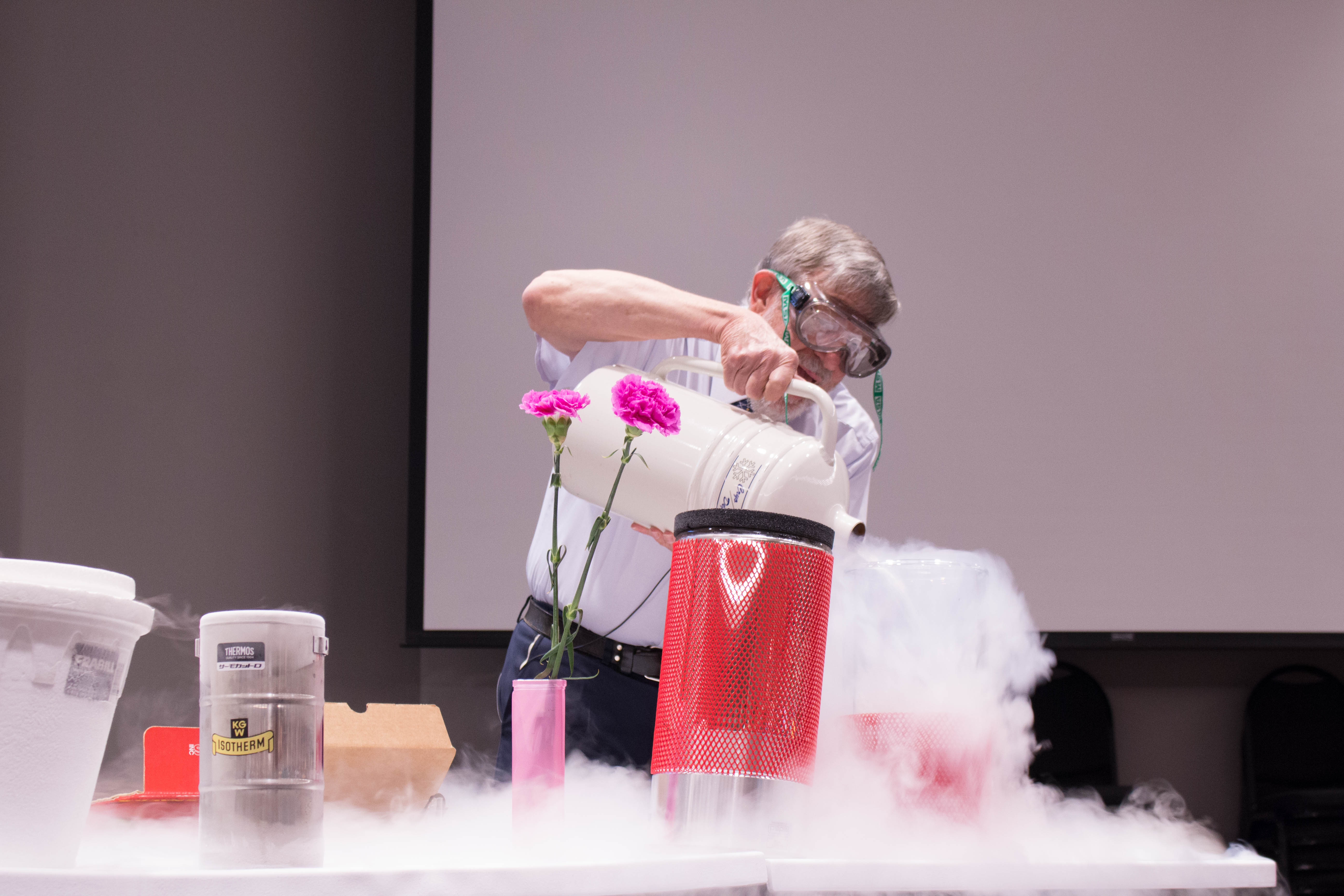
Smashing frozen solid rubber balls into oblivion on the black concrete floor of Alumni Hall in our very own Brumbaugh Academic Center was cool (pun intended) to watch, but more fascinating was watching the crowd. Each face lit up with excitement as they watched each new demonstration. By far the most interesting faces to watch were those of the professor emeriti, those scholars and teachers that have retired from Juniata, several of whom taught Dr. Phillips when he attended Juniata. Their stoic faces broke into easy smiles with each joke and one was even giddy with excitement with each new revelation of a physical phenomenon. And the best moment of them all was when a water bottle filled with liquid nitrogen and placed under a trashcan, exploded launching the trash can up in the air causing the entire audience to jump and my heart to stop for a few seconds.
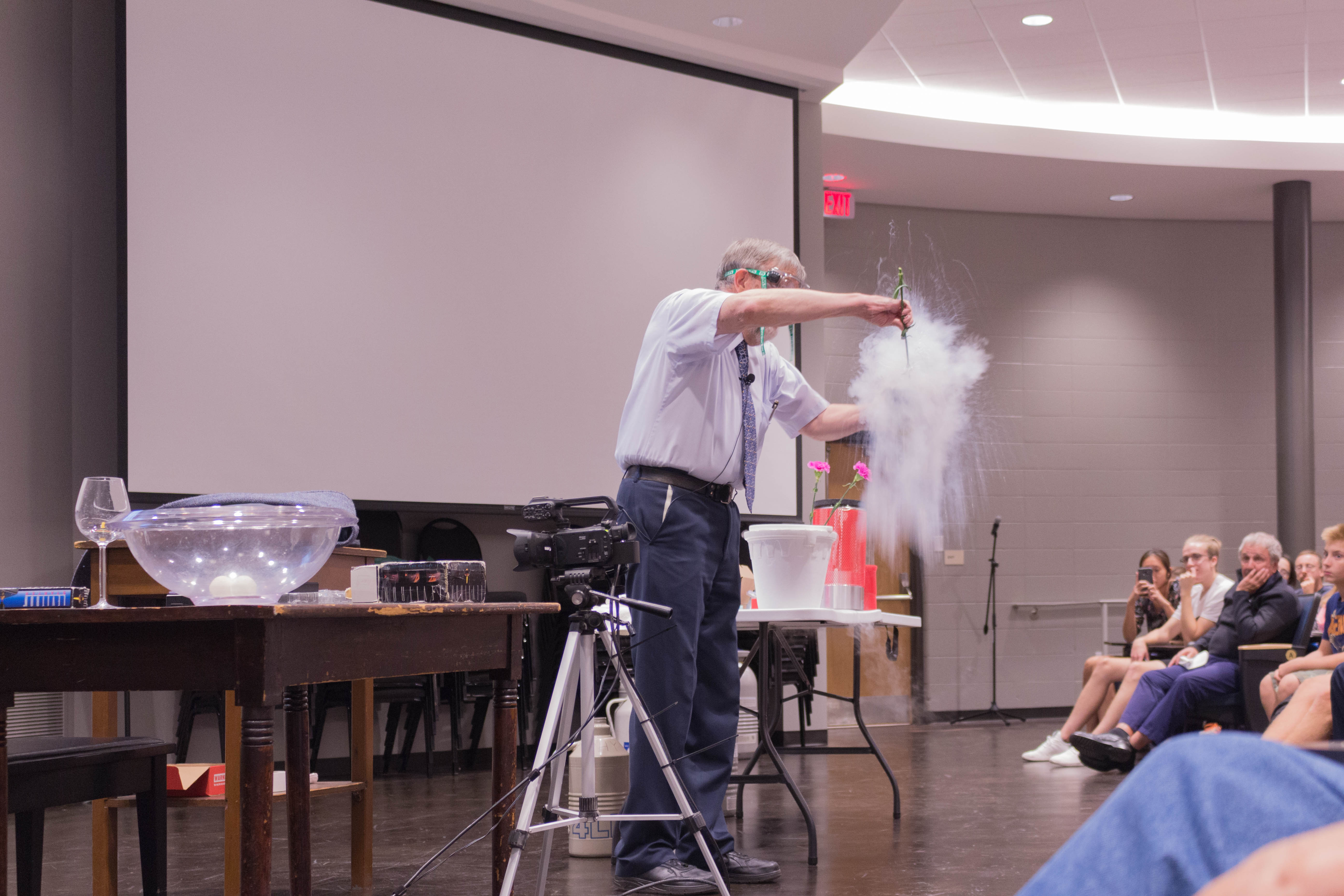
Bill Phillips most influential contribution to this campus did not come in his relation of physics to students of his alma mater, but in an answer to a question from a young audience member after his talk had concluded. The student asked what, if anything he would tell his younger self. He answered by telling a story of a time during his junior year at Juniata College when a physics professor from Princeton came to give a talk. During the question and answer portion the Juniata students asked about graduate school and getting into Princeton and the speaker gave the rather flippant answer that no one from Juniata could ever get into Princeton.
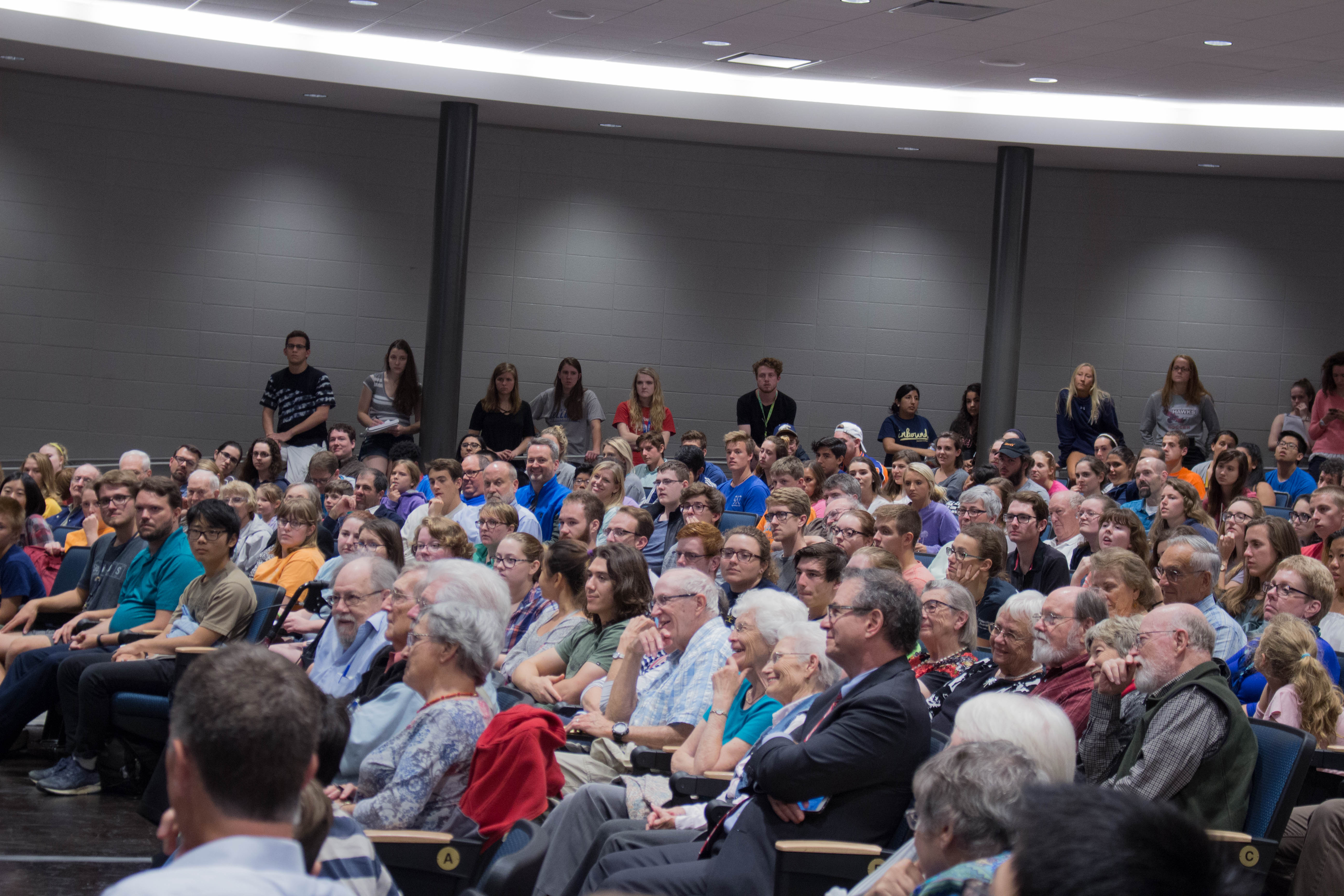
Bill Phillips took that information and proceeded to ignore it as he not only applied to Princeton, but also Harvard and MIT. His overarching point with the story was to not let anyone ever sell you short, especially if you are a Juniatian. That really hit home for me as I am now applying to graduate school and worrying if I will get accepted. What I tend to forget is that here at Juniata we are almost over prepared for our futures. If you choose to come to Juniata for the four years of your undergraduate study you are sure to embark on a difficult journey. Fun? Absolutely! Fulfilling? Of course. Difficult? Definitely. But we are better students and people for having gone through those difficult times.
Even if you are not a Juniatian now and even if you never will be. Remember to never let anyone sell you short. Show them what you can do and prove them all wrong. You might be surprised how far you get. Maybe you’ll even win a Nobel Prize.
You can find the video mentioned in this blog at: https://www.youtube.com/watch?v=HzESTv7ohhY
Out of the Darkness
On October 1st Juniata College hosted a suicide awareness walk called ‘Out of the Darkness’. The purpose of this walk was to raise awareness and funds for suicide prevention and prevention programs. They had three speakers for the opening ceremony, one was our own campus Chaplin who had a moment of silence to honor those lost as well as say a few words for those left behind and another speaker told a touching story about how suicide has affected her life. She talked about how her fiancé had committed suicide and not long after that she lost her brother to suicide as well. Many of the people in the crowd were brought to tears by her story. People from all over were involved in the walk; some were people of the community, staff of the College, or students.
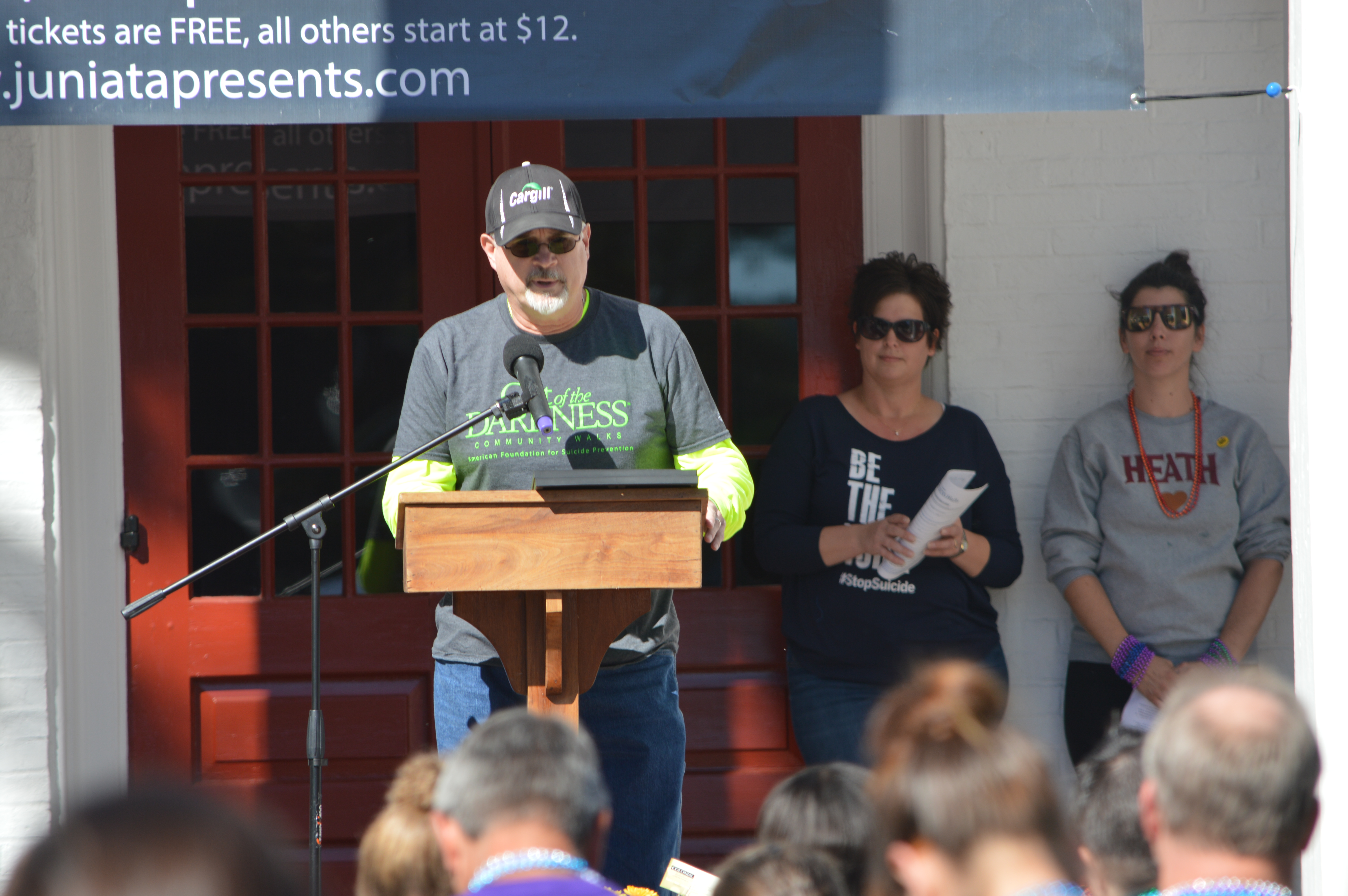
The procession for the mile-long walk was a sight to see, I didn’t expect so many people to show up to support suicide awareness. You never know whose life has been affected by suicide. My friend Ann and I joined the walkers as they marched around our campus. Some of them were somber and talking about people they had lost to suicide, how hard it had been for them and how they never want anyone to have to go through the same things that they have. Others were laughing while they talked about lost loved ones, remembering the good times they could have with those people who were important to them. Everyone was very supportive of each other and there was a very large age range, from toddlers to the elderly. It was a beautiful thing to see and experience.
I personally have not been affected by suicide but know several people who have and I have seen how hard it is for them. Often the people left behind will blame themselves and wonder what they could have done differently. It’s difficult to watch and something that no one should have to go through. I’m proud to be a part of a College that would host this awareness walk and that so many participated. I feel that suicide isn’t talked about enough and people don’t have all the information they need to keep their family members or themselves safe. It’s something that people need to know about, it could happen to anyone and it is something that can be prevented if the correct measures are taken.
The Juniata Sky
One of the best things about Juniata is the sky. This may seem odd to say, as almost everywhere in the world is guaranteed to have a sky of some manner. But there is something special about the sky in and around 40.48° N, 78.01° W that sets it apart from the sky anywhere else in the world. I personally have had many formative experiences—messy and beautiful alike—underneath that sky. It is the backdrop to enough of my memories that I won’t ever forget it.
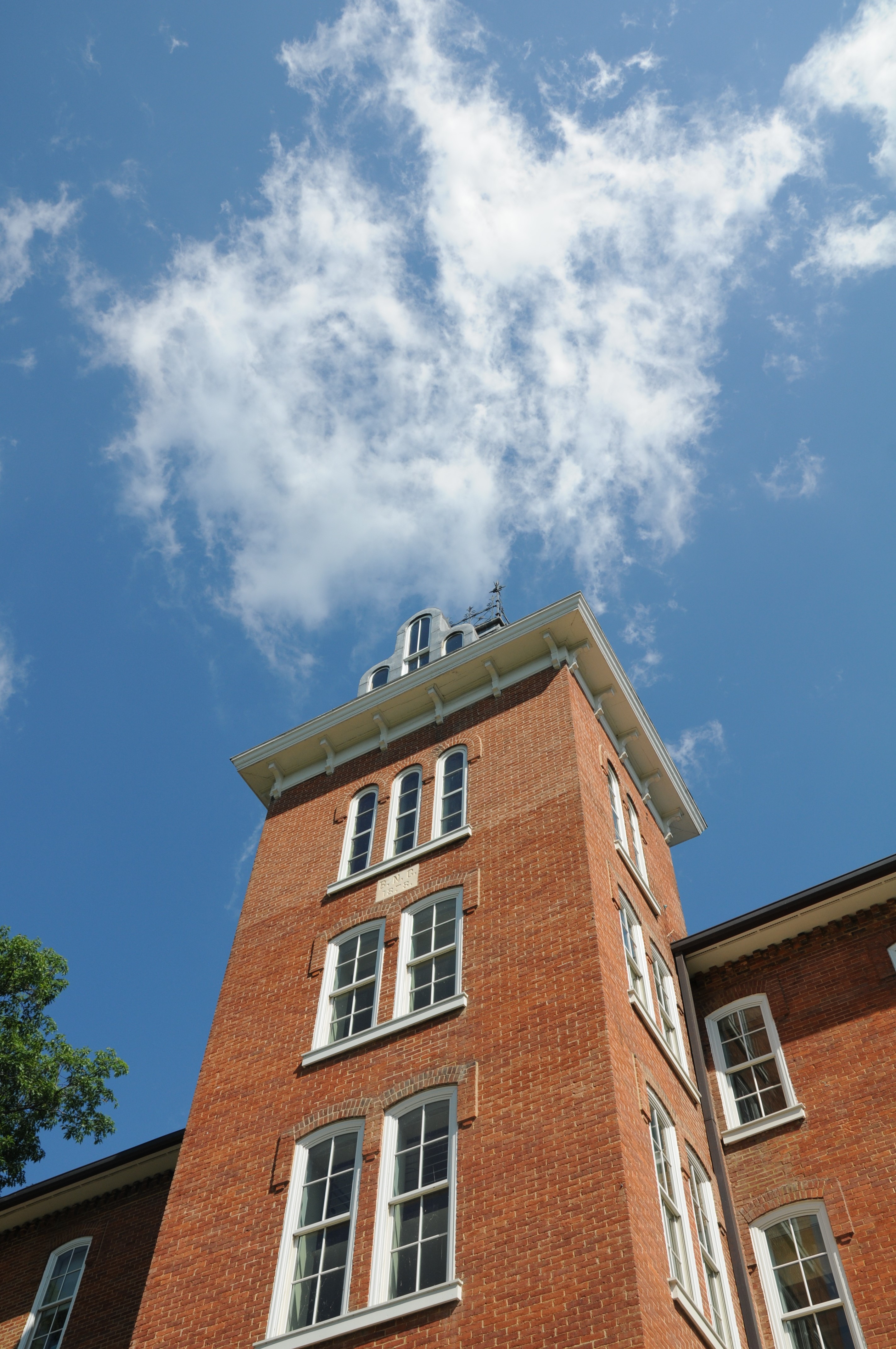
Last Wednesday, the ISS made a spectacular transit of our night sky. It flew for nearly 6 minutes, compared to an average of 3 (link: https://spotthestation.nasa.gov/sightings/view.cfm?country=United_States®ion=Pennsylvania&city=Huntingdon#.WdMIW2hSxEY), and went almost directly overhead. With the minimal light pollution from the College and surrounding town it was a spectacular show. Other satellites, too, frequently overfly our sky. A more skilled astronomer than I would be able to look them up based on no more than the time and their tracks. Thankfully for astronomical illiterates like me, yes, there is an app for that.
The Juniata sky is not the only sky discussed here, however. Just the other day we had a talk by Dr. Kiri Wagstaff, the tactical planner and uplink lead for the Mars Exploration Rover, on how the rover’s movements were organized. It takes a large team all morning to finalize the next day’s schedule. I can’t imagine how my life would look if as much thought were put into one hour of it as was put into one hour of the rover’s day. Perhaps the lesson here is that I need a planning committee for my own day?
With midterms looming it certainly feels this way. Between my jobs on campus—including writing blogs like these and working with students to develop their writing skills at our Writing Center—and the academic responsibilities of a senior it can be difficult to get out and appreciate the Juniata sky. Yet when I do find a chance to go outside and stare up at the stars, even if it’s only for a few minutes, it makes me appreciate where I am that much more.